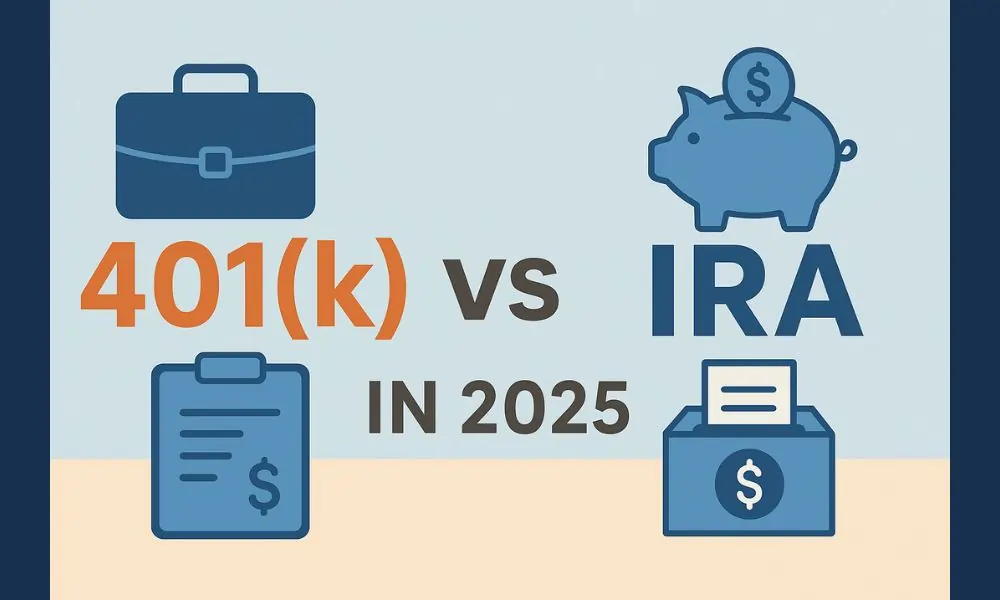
401 (k) vs IRA in 2025: Which Retirement Account is Best for You?
Brief Introduction of 401 (k) vs IRA in 2025
401(k):
“If your employer offers it, a 401(k) lets you save with pre-tax dollars, often matched, growing your nest egg faster in 2025.”
IRA:
“An IRA, openable by anyone with earned income, offers broader investment choices and flexible tax benefits on retirement savings.”
Features of 401 (k) vs IRA in 2025 Retirement Scheme
Features of 401(k) Retirement Scheme
- High annual contribution limit: up to $23,500; $31,000 for those 50+ in 2025.
- Employer match often available—free money boosting your savings.
- Payroll deduction ensures consistent contributions—easy habit-building.
- Loan provisions allow borrowing from your balance penalty-free in emergencies.
- Limited investment menu per employer plan; could mean higher fees or fewer options.
Features of IRA Retirement Scheme
- Open to anyone with earned income—even self-employed or spouse.
- Smaller limits: $7,000; $8,000 for 50+ (2025).
- Broad investment selection—stocks, ETFs, mutual funds, even real estate.
- No employer match—but full control over contributions and investments.
- Roth options provide tax-free withdrawals and no required minimum distributions (RMDs).
Benefits of 401 (k) vs IRA in 2025 Retirement Scheme
Benefits of 401(k) Retirement Scheme
- Employer match dramatically accelerates savings—don’t leave money behind.
- High contribution cap means you can stash more away each year.
- Automatic payroll deductions create a smooth savings habit.
- Early access via loans offers flexibility in tight situations.
Benefits of IRA Retirement Scheme
- Investment flexibility gives you control over asset choices.
- Roth IRA tax-free growth offers long-term tax peace of mind.
- Greater flexibility: easier rollovers, no employer ties, full control.
- No RMD for Roth IRAs, letting your savings grow longer or benefit heirs.
Which Retirement Scheme Is Best – Comparison of 401 (k) vs IRA in 2025
You, the American saver in 2025, face rising costs—from housing to inflation to healthcare. You want retirement security without overwhelm. Here’s how the two stack up:
| Scenario | Recommended Account |
| You get an employer match | Max 401(k) to grab free matching funds. |
| You crave choice & control | IRA shines with varied investments and flexibility. |
| Tax planning—pay later or now? | Traditional 401(k)/IRA cuts taxes today; Roth IRA protects tomorrow. |
| You want both tax types | Use both accounts to diversify tax exposure over retirement. |
| You earn too much for IRA deduction | 401(k) avoids income limits—full tax benefit always. |
Most people benefit from using both—start with the employer match, then diversify with an IRA for flexibility and long-term tax planning.
What Does It Mean for You regarding 401 (k) vs IRA in 2025?
It means more than just saving. Imagine every paycheck working quietly for your future. Your 401(k) delivers immediate value with employer match and higher limits, while an IRA offers freedom, control, and tax advantages. Using both together is like building two safety nets—you reduce stress, prepare for surprises, and give your family peace of mind. It’s about taking control in uncertain economic times and feeling confident about tomorrow.
Conclusion of Article – 401 (k) vs IRA in 2025 Retirement Scheme
By 2025, the best retirement plan blends both: start with the 401(k) to grab employer match and high limits; then add an IRA for choice, tax flexibility, and long-term growth. This combined strategy empowers you to fight uncertainty with confidence, ensuring a stronger, stress-free retirement future.
Related Article – Must Read
References
- Fidelity comparison overview of IRAs vs 401(k)s
- Citizens Bank details on contribution limits and differences
- Vanguard’s 2025 limits table for 401(k) and IRA
FAQs – 401 (k) vs IRA in 2025 Retirement Scheme.
Q1. What’s the 2025 contribution limit for a 401(k)?
In 2025, you can contribute up to $23,500 if under 50. For those aged 50 and above, the limit rises to $31,000, giving older savers a stronger catch-up opportunity.
Q2. How much can I contribute to an IRA in 2025?
IRA contributions are capped at $7,000 for under 50, and $8,000 for age 50 or older. These lower limits mean IRAs are great complements to a 401(k), not full replacements.
Q3. Can I open an IRA even if my employer offers a 401(k)?
Yes. Having a 401(k) doesn’t block you from opening an IRA. Many savers use both accounts together to maximize retirement benefits.
Q4. Is there an employer match for IRAs?
No. Unlike 401(k)s, IRAs don’t come with employer contributions. But they offer unmatched flexibility and a wide variety of investment choices.
Q5. What are the main tax differences?
Traditional accounts reduce taxable income today, while Roth accounts provide tax-free withdrawals in retirement. This choice lets you decide whether to save on taxes now or later.
Q6. Are there RMDs for Roth IRAs?
Roth IRAs have no required minimum distributions. That means your savings can keep growing tax-free indefinitely, or you can leave them for heirs.
Q7. Can I take a loan from a 401(k)?
Yes. Many plans allow loans up to $50,000 without tax penalties, which can help in emergencies. But remember, it reduces your invested balance until repaid.
Q8. Can high earners use Roth IRAs in 2025?
Income limits still restrict direct Roth contributions for high earners. However, Roth 401(k)s have no income caps, making them a strong alternative for those above the threshold.
Q9. Should I use both accounts?
Absolutely. The smartest approach is to take full advantage of your 401(k) match first, then add IRA contributions for broader choices and tax diversification.
Q10. What’s the smart tax strategy for today’s low rates?
With tax rates expected to rise, many experts suggest converting some savings into Roth accounts now. Paying tax today may save you more tomorrow.