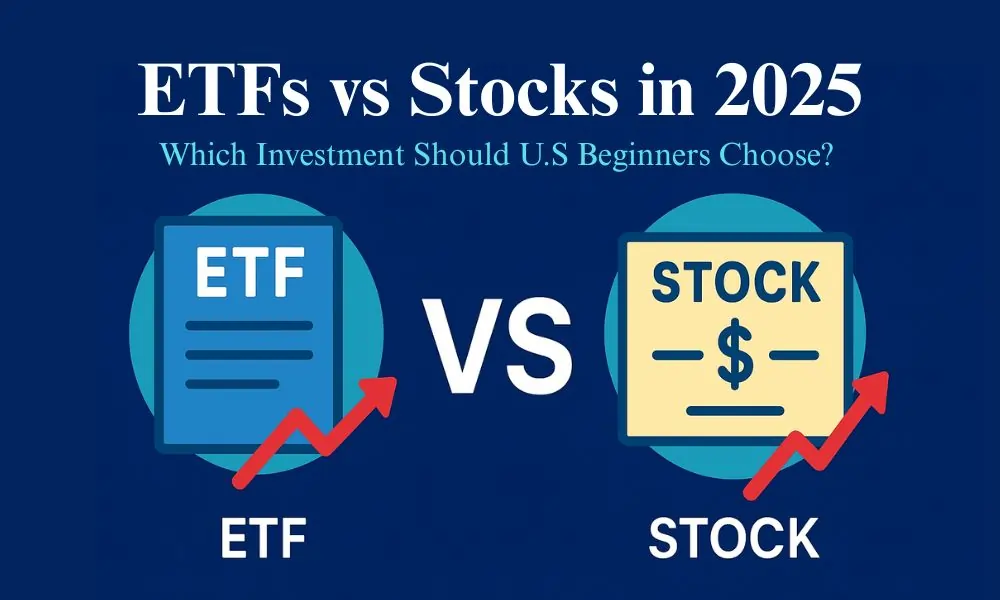
ETFs vs Stocks in 2025: Which Investment Should U.S. Beginners Choose?
Introduction: ETFs vs Stocks as Smart Investments for Americans in 2025
The year 2025 is shaping up to be a critical time for American investors. With the U.S. economy stabilizing after inflationary pressures of the last few years, more beginners are entering the financial markets. For many, the biggest question remains: Should I put my money into ETFs or individual stocks?
Both investments play a vital role in wealth-building strategies. ETFs (Exchange-Traded Funds) offer diversification and lower risk, while stocks can deliver higher returns but come with volatility. This article will break down ETFs vs Stocks 2025 for Beginners, explain how each works, and help you decide which path may be best for you in today’s U.S. market conditions.
What Are ETFs? (A Simple Guide for U.S. Beginners)
An ETF is like a basket of investments. Instead of buying one company’s stock, you invest in a fund that tracks multiple companies, bonds, or even sectors.
- ETFs trade like stocks on U.S. exchanges.
- They are considered beginner-friendly due to diversification.
- Popular examples in the U.S. include SPDR S&P 500 ETF (SPY) and Vanguard Total Stock Market ETF (VTI).
For U.S. beginners in 2025, ETFs remain one of the easiest ways to get broad market exposure without picking individual winners.
What Are Stocks? (A Simple Guide for U.S. Beginners)
Stocks represent ownership in a single U.S. company. When you buy a stock, you own a share of that company’s future profits.
- Stock prices rise or fall based on company performance and the U.S. economy.
- Returns can be much higher than ETFs but riskier.
- Example: owning Apple (AAPL) or Tesla (TSLA) directly.
For Americans in 2025, investing in stocks may feel exciting but requires patience and research.
How Does ETF Investment Work in the U.S. Market?
ETF investing is simple:
- Open a brokerage account.
- Search for the ETF ticker symbol.
- Buy shares just like you would buy stocks.
In 2025, many U.S. brokerages, like Fidelity and Charles Schwab, offer commission-free ETF trading, making it cost-effective for beginners.
How Does Stock Investment Work in the U.S. Stock Market?
Stock investing requires selecting companies you believe will grow.
- Research U.S. companies and industries.
- Monitor quarterly earnings and economic news.
- Manage risk by not putting all money in one company.
Beginners in 2025 often use fractional shares, allowing them to invest in high-priced stocks like Amazon or Google with as little as $5.
Ways to Invest in ETFs and Stocks in the U.S. in 2025
Beginners in America have multiple options:
- Online Brokers: Robinhood, Fidelity, Charles Schwab.
- Robo-Advisors: Betterment, Wealthfront (automatically invest in ETFs).
- Retirement Accounts: 401(k) and IRA plans.
- Apps for Students: Acorns or Stash.
This flexibility makes ETFs vs Stocks 2025 for Beginners accessible to almost everyone.
Risks and Liabilities of ETFs vs Stocks for American Investors
- ETFs: Less risky but can still lose value during U.S. market downturns. Sector-specific ETFs may fall sharply.
- Stocks: High risk, especially in volatile 2025 sectors like tech and energy. Individual companies can collapse.
Risk management is key — diversifies and never invests money you can’t afford to lose.
Which Is Better for Beginners in the U.S.: ETFs or Stocks?
For most beginners in America, ETFs are safer in 2025 because they spread risk across many companies. Stocks are better for those who enjoy research and can handle market ups and downs.
A balanced approach often works best: start with ETFs, and then add individual stocks once you gain confidence.
How Can American Students Start Investing with Small Amounts?
Yes, U.S. students can start with very little. Many platforms allow fractional investing or “round-up” investing from everyday purchases.
- Start with $10–$20 in low-cost ETFs.
- Explore fractional shares of big-name stocks.
- Focus on learning rather than chasing fast returns.
This makes ETFs vs Stocks 2025 for Beginners relevant not just to working adults but also to college students building financial habits early.
Conclusion: Best Investment Choice for U.S. Beginners in 2025
In 2025, the U.S. economy offers unique opportunities for beginners. ETFs provide safety, diversification, and easy access, while stocks offer higher potential rewards but more risk. For most new investors, starting with ETFs and gradually adding stocks is the smart move.
Whether you’re a working professional or a student, the key is to start early, stay consistent, and think long-term.
References
- Investopedia – ETFs Explained
- U.S. Securities and Exchange Commission (SEC) – Beginners’ Guide to Investing
- Morningstar – ETF vs Stock Investing
Disclaimer
The information provided in this article is for educational and informational purposes only. It should not be considered financial, investment, or legal advice. Investing in ETFs, stocks, or any other financial instruments carries risk, including the possible loss of principal. Past performance is not indicative of future results.
We do not endorse, recommend, or promote any specific brokerage platforms, apps, tools, or investment agencies mentioned in this article. Readers are encouraged to conduct their own research or consult with a licensed financial advisor before making any investment decisions.
Related Topic – Must Read
FAQs – ETFs vs Stocks 2025 for Beginners
Q1. What is safer for U.S. beginners in 2025, ETFs or stocks?
ETFs are generally safer since they spread your money across many companies, while stocks carry higher risk.
Q2. Can I lose money in ETFs in 2025?
Yes, ETFs can decline during U.S. market downturns, though they’re usually less volatile than single stocks.
Q3. Are ETFs cheaper than stocks for American investors?
Yes, ETFs often have low expense ratios and no trading commission on major U.S. brokerages.
Q4. What’s the minimum amount to start investing in ETFs in the U.S.?
Many ETFs can be bought for under $100, and some brokers allow fractional investing for as low as $1.
Q5. Which U.S. broker is best for beginners in 2025?
Fidelity, Robinhood, and Charles Schwab are popular among American beginners.
Q6. Do ETFs pay dividends in the U.S.?
Yes, many U.S. ETFs pay dividends just like stocks, which can be reinvested.
Q7. Can American students legally invest in ETFs and stocks?
Yes, students over 18 can open brokerage accounts and invest with small amounts.
Q8. Which is better for long-term wealth in the U.S., ETFs or stocks?
ETFs are better for long-term passive growth, while stocks are better for higher-risk, higher-reward strategies.
Q9. Are ETFs taxed differently from stocks in the U.S.?
Both are subject to U.S. capital gains taxes, but ETFs are generally more tax-efficient.
Q10. Should beginners in 2025 start with ETFs or stocks first?
ETFs are the recommended starting point, and beginners can add stocks later as they gain confidence.