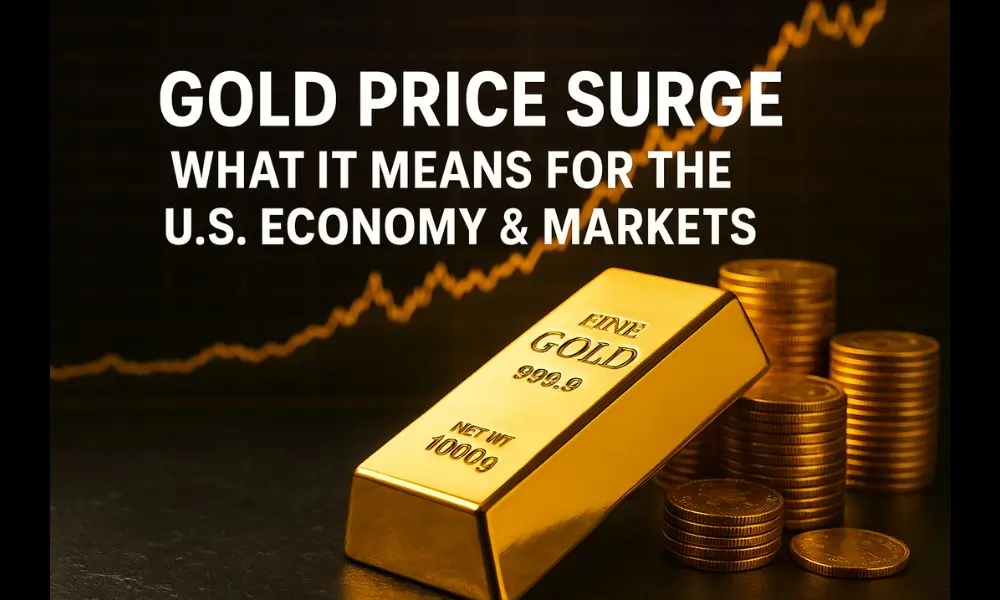
Gold Price Surge Tops $4,300 — What It Means for the U.S. Economy and Your Portfolio
Quick Summary: Gold has surged past $4,300 amid U.S.–China tensions and rate-cut bets. Learn how this rally signals shifting market dynamics, and how Americans’ investments might be affected in 2025.
A Golden Run You Can’t Ignore
Over the past weeks, gold has broken records — surging past $4,300 an ounce as investors scramble toward safe havens in a choppy market. This isn’t just about precious metals; it’s a vivid signal flashing red for U.S. equity traders, bond investors, and everyday savers. The gold price surge is real — and its ripples stretch across the U.S. economy and your personal finance landscape.
Why Gold Is Rallying
Here’s what’s driving the rally:
- Fed rate-cut expectations: Traders are pricing in multiple quarter-point cuts by year-end. That’s good news for non-yielding assets like gold.
- Credit fears & bank stress: Notices from U.S. regional lenders about bad loans and fraud have spooked markets. Confidence is shaky.
- Geopolitical heat: Renewed U.S.–China tensions and global uncertainty add fuel to risk aversion.
- ETF & institutional inflows: Gold exchange-traded funds are seeing huge inflows, and central banks continue to buy.
Michael Widmer at Bank of America noted the “ETF inflows up 880% year-over-year — that’s a concern for sustainability.” But he also admitted the fundamentals pushing gold remain intact.
What It Means for the U.S. Economy & Markets
When gold leaps, it often whispers warnings:
- Stocks under pressure: Capital is flowing out of equities into safer assets. That can drag U.S. indices lower if sentiment sours.
- Bond yields & real interest rates: If rate cuts accelerate, real yields could go negative — making gold look relatively more attractive.
- Inflation hedge demand: With inflation sticky in the U.S., gold becomes a go-to.
- Dollar weakness risk: A weakening USD both supports gold and signals deeper macro trouble.
HSBC recently lifted its 2025 gold forecast to $3,355, while ANZ expects the metal to hit $4,400 by end-2025 and perhaps top $4,600 by mid-2026 before easing. Goldman Sachs sees a 6% rise into mid-2026. And get this — JPMorgan CEO Jamie Dimon now hints gold could someday reach $5,000–$10,000.
How This Affects You
If you live in Phoenix, New York City, Austin — it doesn’t matter — here’s what to watch:
- Retirement & savings: Gold in your portfolio (say, 5–15%) might buffer you when stocks wobble.
- Home equity & debt: Rising gold often comes hand in hand with concern about inflation, interest rates, and debt costs.
- Stock market timing: A gold rally of this magnitude could signal a longer equity correction ahead.
All told, this isn’t a fringe story. It’s a major financial moment.
Recent News Article – Must Read
FAQs
Q1. What’s fueling the gold price surge?
Mostly expectations of U.S. Federal Reserve rate cuts, credit concerns from troubled banks, and geopolitical risk (especially U.S.–China tensions).
Q2. How does this affect U.S. inflation and interest rates?
The rally suggests markets doubt future rate hikes. If inflation stays stubborn, the Fed might hesitate, creating negative real yields — which bolsters gold.
Q3. Should U.S. investors shift into gold now?
It depends on risk appetite. A modest gold allocation (5–15%) can hedge a volatile equity portfolio. But timing matters — entering after big jumps is risky.
Q4. Is the gold rally signaling a stock market downturn?
Not necessarily always, but capital flows into safe havens often accompany weaker equity sentiment, so it’s a warning flag.
Q5. Could gold fall in 2026?
Yes, analysts believe gold may top out by mid-2026 if the Fed eases fully. Some forecasts expect a downward correction later in 2026.