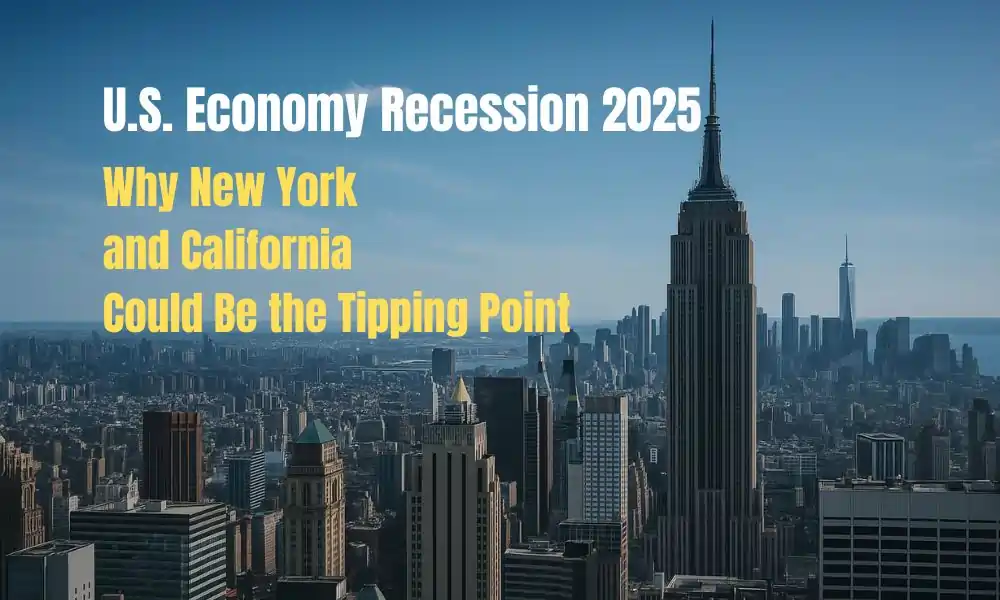
U.S. Economy Recession 2025: Why New York and California Could Be the Tipping Point
Quick Summary: California and New York’s slowing growth could signal a wider U.S. economy recession in 2025, threatening jobs, markets, and personal finances as inflation, credit costs, and state challenges mount.
America’s Economic Pulse May Depend on Two States
If you’re worried about the U.S. economy recession in 2025, keep an eye on two familiar names — California and New York. These aren’t just states; they’re economic engines driving nearly a quarter of U.S. GDP. When either sneezes, the rest of America tends to catch a cold.
Economists like Scott Anderson of BMO Capital Markets are sounding cautious alarms. “They may be canaries in the coal mine,” he said — hinting that weakness in these powerhouses could drag the U.S. job market and stock market into trouble.
California’s Slowdown: The Warning Light for U.S. Inflation and Jobs
California, often the golden child of innovation, is showing some dull spots. Job losses have topped 20,000 this year, unemployment hovers around 5.5%, and tech layoffs aren’t slowing. The state’s housing crisis and high living costs have turned relocation into a new normal.
Even with higher consumer spending than the national average, the underlying trend feels uneasy. Economists from the UCLA Anderson School forecast sluggish growth until 2027, with a mild recession still possible.
Here’s what’s fueling California’s drag:
- The tech sector faces uncertainty due to AI automation and reduced hiring.
- Immigration policies are straining industries like hospitality, construction, and manufacturing.
- U.S. inflation continues to pressure living costs and business margins.
- Stock market volatility is reducing tax revenue tied to capital gains.
It’s a mix that leaves even optimistic analysts cautious. And as history shows, when California slows down, the U.S. economy often follows.
New York’s Resilience May Not Last
Meanwhile, New York — home to Wall Street’s heartbeat — looks steady on paper. Job growth is stable, unemployment sits near 4%, and finance is booming. But beneath that shine, economists see cracks.
New York’s economy leans heavily on finance and real estate, sectors that could wobble if ETF vs stocks sentiment shifts or markets tumble. The Tax Foundation’s 2025 index ranks New York dead last for tax competitiveness, and that’s already pushing firms — and people — to relocate southward.
Professor Carl Schramm from Syracuse University calls it “a quiet outmigration crisis.” With over 2 million residents lost in the past decade, the state risks shrinking its tax base — and that’s bad news for everyone left behind.
How a State Recession Could Hit Your Wallet
If California or New York fall into recession, here’s how it could affect everyday Americans:
- Credit Cards: Higher default risk means banks tighten limits and raise rates.
- Job Market: Hiring freezes could spread nationwide, especially in finance, tech, and logistics.
- ETF vs Stocks: Market volatility may favor safer ETFs as investors avoid riskier tech or real estate plays.
- Personal Finance: Rising costs and falling wages could erode household savings faster than expected.
A downturn in these two states would quickly ripple through to U.S. inflation, consumer confidence, and national spending habits — the perfect storm for a U.S. economy recession in 2025.
Conclusion
It’s not all doom and gloom — yet. Economists say that unless global trade worsens or stock markets take a sharp dive, a nationwide recession can still be avoided. But for now, California and New York remain the economy’s biggest question marks.
When two of America’s richest states start stalling, the rest of us have to wonder: Is this just a slowdown — or the start of the next big downturn?
Recent News Article – Must Read
FAQs
Q1. Why could California and New York trigger a U.S. economy recession in 2025?
Because together they contribute nearly 25% of America’s GDP. A slowdown in their industries, jobs, and spending can drag down the national growth rate quickly.
Q2. How does U.S. inflation connect to state-level slowdowns?
When inflation stays high, borrowing costs and living expenses rise — weakening consumer spending, especially in high-cost states like California and New York.
Q3. Are ETFs safer than stocks during a recession?
ETFs offer diversification, which may cushion against losses, but if sectors like tech and real estate fall, both ETFs and individual stocks can take a hit.
Q4. Will credit card rates rise if a recession hits?
Yes, During recessions, lenders tighten credit, raise interest rates, and lower limits — making it harder for consumers to manage personal finance.
Q5. Which sectors could remain stable?
Healthcare, government, and education may hold steady, while luxury spending, entertainment, and construction are likely to face sharper declines.